

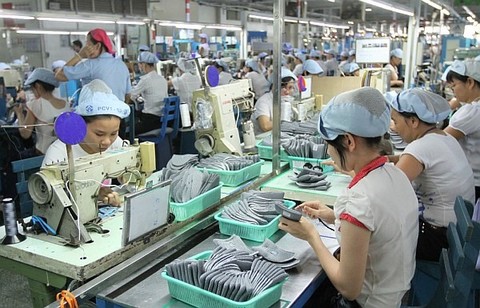
Workers process shoes in a FDI enterprise’s factory in Viet Nam.
According to the latest statistics of the World Footwear Magazine in 2017, Viet Nam continued to rank second among the top 10 largest footwear exporters, with 1.02 billion pairs of shoes, equivalent to 7.4 per cent of the global footwear supply, said Diep Thanh Kiet, vice chairman of the Viet Nam Leather, Footwear and Handbag Association (LEFASO).
China still maintained the top position in exporting shoes, with 9.31 billion pairs, representing 67.3 per cent of the total 23 billion pairs of shoes the world consumed in 2017.
Asia continued to be recognised as the world’s leading region in the production and consumption of footwear throughout the world.
Meanwhile, the United States was the largest footwear importer; the country imported 2.34 billion pairs of shoes last year, accounting for 19.6 per cent of global footwear consumption.
Export of Viet Nam’s backpacks and handbags continued to rise, to make it to the top five countries exporting these products in the world today.
In 2017, the export turnover of backpacks and handbags in Viet Nam was estimated at US$3.3 billion, accounting for 5.5 per cent of global production, but only about one-seventh as compared to China’s supply.
Kiet said the biggest challenge for the domestic footwear-handbags industry was the low level of technology application in management and production, as compared to regional and foreign direct investment (FDI) enterprises.
The labour productivity of domestic enterprises was only equal to 60-70 per cent of FDI enterprises. Most domestic firms have not joined the global supply chain; meanwhile, international brands usually tend to deeply control the global supply chain. In addition, labour costs in Viet Nam were rising significantly, Kiet added.
Not only interfering in the price of the goods, importers were now gradually intervening in the traceability of raw materials and factories supplying machinery for production.
On the other hand, the time taken for supplying goods, product confidentiality, the level of technology used, and advantages of raw material supply are given priority to help consumers select where to place an order and process production, Kiet said. — VNS


